

How to Create Your Own Baking Recipes


One of my favorite parts of baking is developing my own recipes. I get to be creative and let inspiration guide me as I play with flavors, textures, colors, and so much more. Learn how to create your own baking recipes too!
This page may contain affiliate links which means I may earn a commission as an Amazon Associate (or other affiliate program) from qualifying purchases. I only recommend products that I use and trust.
Inspiration
Before you can create your own recipe, you need to have a starting point. It could be a flavor, texture, bake, or really anything that is leading the vision behind your recipe. Random tangent – Inside the Box is a fascinating nonfiction book about how constraints can actually make us more creative.

If you’re struggling for inspiration, try thinking of desserts that you already like. Can you reimagine a candy bar as a macaron? Turn a drink on a boba menu into cupcakes? Look at the Starbucks menu for flavor ideas. I also adore my flavor thesaurus and the sequel. Inspiration is everywhere.
Recipe Search
Once you have that initial idea, you’ll need to figure out what type of bake you’ll make and what recipe you’ll use as your base. Yes, generally speaking when you develop a recipe, you’ll still use at least one recipe as your starting point. As you become more experienced at recipe development, you may find that you like researching multiple base recipes and figuring out how to incorporate elements from each to create something new.

This coffee cake layer cake started off with a reverse creaming recipe from a trusted cookbook. Then I switched to a regular creaming method recipe. Over the years, I tweaked that to incorporate oil AND butter, as well as dried buttermilk and cake enhancer. Each time I baked my cake recipe, I tweaked it just a bit until it landed where I wanted it.
Balancing Textures
When crafting your new recipe, keep texture in mind. Most of the time, you’ll want to balance soft and crunchy elements to create a dessert that is interesting to eat. That being said, sometimes all soft or all crunchy is a good choice. But it must be an intentional choice, otherwise it won’t land.

I find soft recipe elements are easy to think of. Cakes, mousses, buttercreams, the list goes on. Crunchy is where I have to rack my brain. Try throwing a baked streusel in between cake layers, or a cookie crumble in a tart, or even a crispy sable under an entremet.
Ingredients Are Key
Once you’ve created the vision for the bake, it’s time to create your own recipe to bring it to life. Starting with that base recipe, we’ll tweak it to adjust our flavors. Maybe it’s spices, extracts, or freeze dried fruit.

When you’re messing with a recipe’s ingredients, you need to keep in mind how the ingredient functions in the recipe. You can’t just swap flour for cocoa powder and you can’t remove the eggs and use milk instead. However, you can add a small amount of wet or dry ingredients to many recipes without making drastic changes.
Understand how the ingredients are working together and start with small changes. Say I want to use whole wheat flour instead of all purpose flour. I’d swap out no more than 25% of the ap flour and see how that worked. The two work differently, but by only swapping out a portion, I’m minimizing my risk of blunders.
Related Reading: Understanding Common Cake Ingredients
Blunders Are Inevitable
When you develop your own recipes, blunders are inevitable. The more experience you have, the better your chances are, but sometimes you fly too close to the sun. Embrace that. Figure out why your recipe failed, make changes, and try again.

To improve my chances, I usually like to start with a recipe I know or make only small changes. When I made this coconut cake, I used my own white cake recipe as the base, but changed the pan size and the type of liquid. I knew those changes were unlikely to cause issues because I was so familiar with my base recipe.
Real World Example
So what does it look like to create your own recipe in real life? I have so many examples, but we’ll take a look at a recent one – my passion fruit and ube cheesecake. I was inspired by a book, The Hurricane Wars. The cover is purple and yellow which guided my aesthetic. The story contains elements of southeast Asian culture. These two factors led me to pick ube and passion fruit as my hero flavors.

Knowing I wanted the ube’s rich purple color to be the visual star, I had to pick a bake that wouldn’t brown in the oven, so I went with cheesecake. I figured a purple cheesecake and yellow passion fruit sauce would be gorgeous.
Creating My Recipe
I took my base recipe (a guava cheesecake) and ran with the idea. The cheesecake base would provide a nice crunchy base, ube would be a creamy filling, and passion fruit coulis would add some acidity.
From my original recipe, I made a few calculated swaps. Instead of sweetened condensed milk, I used ube sweetened condensed creamer. Before I made that decision I compared the fat and sugar contents of both to make sure they would operate about the same.
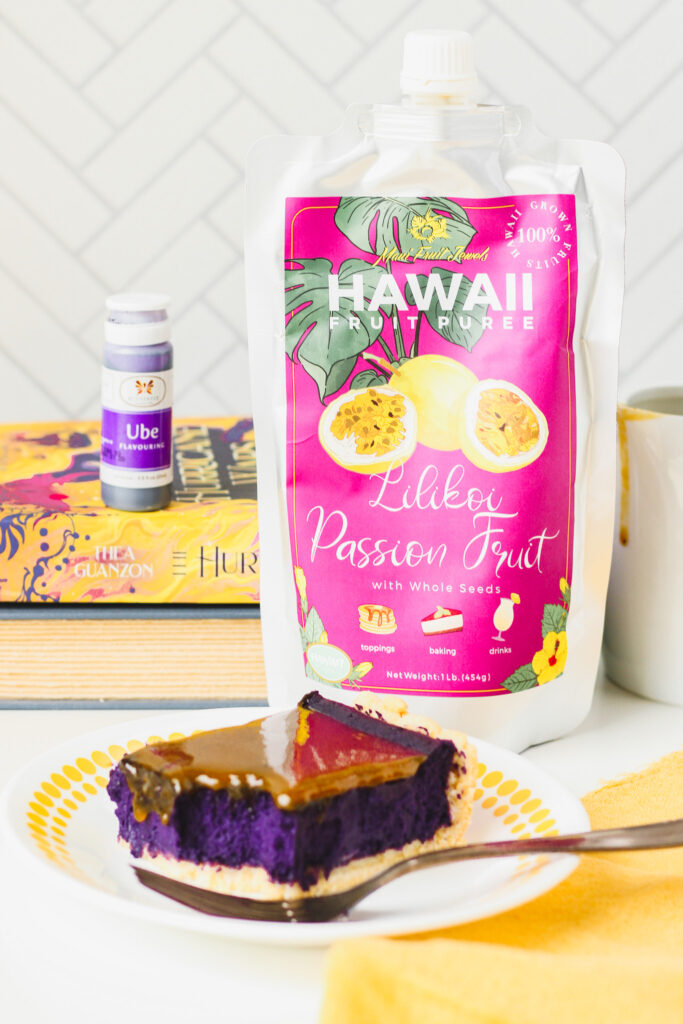
I also needed some sort of liquid for the cheesecake because guava puree would not do. Ultimately I went with light coconut milk. The flavor, while unlikely to be distinct, would not clash with the rest of the cheesecake. It would also add to the richness while not making the cheesecake too dense.
What Went Wrong?
Passion fruit. Just about everything with it went wrong, and yet the dessert still worked. First off, I didn’t realize my puree had the seeds, so that was annoying to sieve out. Then the color! Instead of the lovely yellow color I expected, my puree was nearly orange!
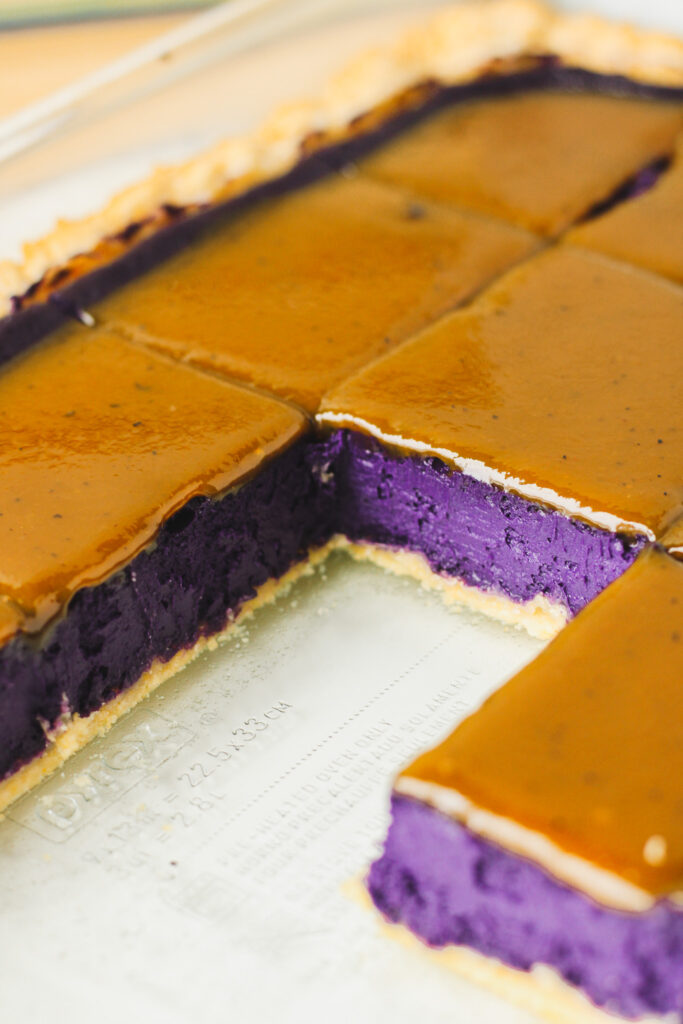
It was also waaayy more tart than I expected. Like, I was worried about giving it to my taste testers. However, I had counted on the acidity pairing with the richness of the cheesecake and that was the saving grace. The ube cheesecake was rich and creamy and there was only a thin layer of passion fruit. Even if it wasn’t the dessert I had originally envisioned, it still tasted and looked great.
Happy Baking!
Baking is a great way to be creative, especially when you’re no longer limited by the recipes you can find. Take the time to practice developing your own recipes and a world of possibilities will open up.

If you ever want to chat about how to create your own baking recipes, send me a message on Instagram!

Colleen
Hi there! I’m Colleen, a novice baker with a passion for learning and improving my bakes… and blunders. On Bakes and Blunders, you can find all sorts of tasty recipes that range in difficulty, but most importantly, I’ll try to explain the reason behind important steps. If you know why a recipe works, you can tweak and adapt it to suit your unique tastes, and you’ll be able to reliably produce some very delicious treats. If you love baking and want to expand and grow your skills, or if you are a casual baker and just need some pointers, my blog is right up your alley! Join me on my baking journey and we’ll learn how to make more impressive recipes together.


You May Also Like

Pumpkin Spice Latte Cupcakes

Wonderful Wednesday Blog Hop 322
